Changing Fingal: Stories from my Place
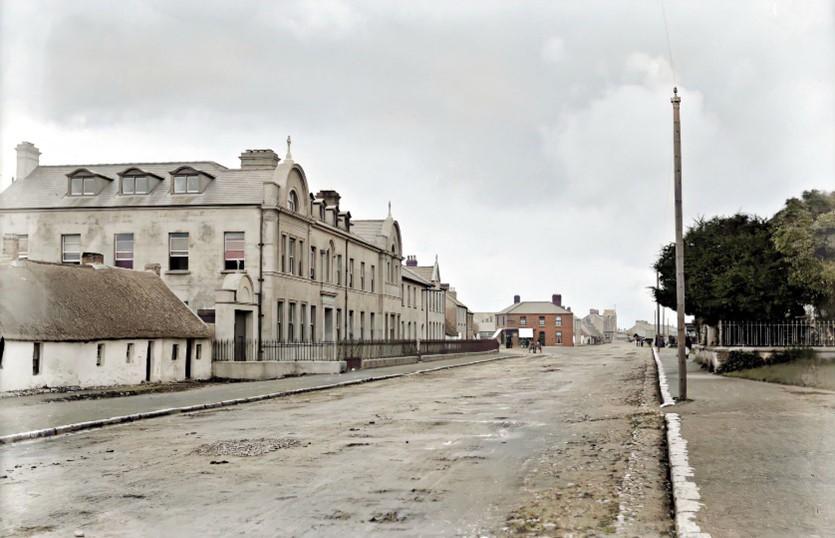
Image: The Convent, Skerries, Eason Collection 1900-1939 © National Library of Ireland
Fingal has seen a lot of change especially in the last century. This project aims to capture the stories and memories of communities across the county. Members of the Fingal Heritage Network are taking a street or village and using Census 1926, maps, photographs and memories to trace the story of our place. Societies are marking the anniversaries-did you know Blanchardstown Brass Band is 200 years old in 1926? Others have captured their main street in photographs while more have traced the stories of their streets and the families that lived there.
View the Changing Fingal Storymap here
Changing Fingal - Balbriggan Our Place
Balbriggan has a rich and varied industrial, maritime and social history. Down through the years events in the town have been of vital local, national and international importance and have had reverberations globally. Here we have selected a number of these individuals who witnessed first-hand key moments in our town's history, and review what we can learn from the various records. Changing Fingal - Balbriggan Our Place
Blanchardstown Brass Band 1826 - 2026
Originally known as St Brigid's Brass & Reed Band, Blanchardstown Brass Band was established in 1826. To celebrate 200 years a Festival of Brass was held in May 2026. This event and interviews with band members was filmed to mark the occasion. Please view here https://vimeo.com/1201701201/e6ad0bf02f
Barrack Lane, Lusk
Aidan Arnold of Lusk Heritage Group examines the history and development of Barrack lane, that stretches southwards from the historic heart of Lusk. Among the surnames associated with the lane during this period were McCann, McNally, Hoare, Reilly, Monks, Byrne, Shiels, Murphy, Hand, White and Callan, many of which can be traced back generations. Barrack Lane Lusk
Inclosing the Commonage: Ten years that changed the Landscape of Lusk forever
The Enclosure Act of 1821, saw the enclosure of the commons at Lusk as a managed legal process. Over the following decade the commons were transformed into privately owned and legally defined holdings putting an end to the medieval system of communal grazing that had shaped the countryside around Lusk for centuries. Inclosing the Commonage: Ten years that changed the Landscape of Lusk forever
Rush and Loughshinny Smugglers in the 18th Century
Thanks to conflicts and unrest throughout the 18th century that resulted in high duties on imports such as tea, tobacco, spices and spirits, smuggling in Fingal really took off. Cepta Butler explores the links with the Isle of Man, Rush Wherries and some of the stories of smuggling in Loughshinny and Rush. Rush and Loughshinny Smugglers in the 18th Century
Rush, the Village Has Changed…the Families Have Stayed
The streetscape has changed, businesses have evolved, and the population has grown, but one thing has remained remarkably constant – the families who have called Rush home. the history of Rush is not simply told through its buildings, but through the generations of people who lived, worked and raised their families here. Read about evolving Rush through the stories of the Walsh, Hoare and Martin families here. Rush the Village has changed the Families have stayed the same
Main Street, Swords
The idea for this project was to record the Main Street as it is now and compare it with how it was one hundred years ago. according to census records, 52 families or households lived on Main Street, Swords in 1926. Main Street, Swords
The Twelve Apostles, Swords
Known locally as the 12 Apostles, the twelve cottages on Rathbeale road were built as part of the Supplemental (Agreement) Scheme 1933. Paul O’Brien and Niall O’Neill. interview some of the present day inhabitants of the 12 Apostles and just what it is like to live there now. Please view here https://vimeo.com/1208080828/e78a8fa575 .
Clonsilla Heritage
Clonsilla or Cluain Saileach means ‘Meadow of the Sally (Willow) tree’. With origins in the early Christian period, Clonsilla formed part of an extensive Anglo-Norman landscape. The 1790s saw the construction of the Royal canal and the 1800s brought the railways along with the construction of big houses and stud farms. While Clonsilla has undergone significant changes in recent years, there is still plenty of heritage to be found. Clonsilla Heritage
Supported by the Heritage Council, this project is an action of the Fingal Heritage Plan 2024-2030